
Thanksgiving Parades. Where Did They Come From?


By Erica and Karen
The Macy’s Thanksgiving Day parade is a beloved New York City institution. But what does a parade by Macy’s have to do with Thanksgiving? Here’s the answer:
In the 1920s, a lot of Macy’s employees were first generation European immigrants. They wanted to celebrate Thanksgiving Day with the type of festival they loved and cherished back home. The first parade took place in 1924, when employees marched through 34th Street dressed as clowns, cowboys, knights and sheikhs. There were floats and professional bands. And to top it all off, there were twenty five live animals borrowed from the Central Park Zoo. The parade was an instant hit and laid a foundation for what would later became one of the most treasured holiday traditions.
n 1927, large balloons depicting cartoon characters like Felix the Cat were introduced. The parade even grew through the Great Depression. In 1934, it was viewed by over 1 million people. Around that time, Walt Disney characters and Santa ballons made their first appearances, along with the parade being broadcasted on the radio.
The parade took place every year thereafter, with some breaks for war and high winds.
Of course there are parades in many other cities as well. Detroit’s parade—America’s Thanksgiving Day Parade—began the same year as the Macy’s Day Parade.
The Thanksgiving parade has been a holiday tradition in Detroit for more than 80 years. Started by Hudson’s, downtown Detroit’s legendary department store, the parade first rolled down Woodward Avenue in 1924, the same year that Macy’s began its parade in New York City.
*****
Detroit’s first Thanksgiving parade featured horses pulling a float decorated with Mother Goose, four papier-mâché heads and seven marching bands. Over the years, the parade’s size and scope has grown significantly, as it has entertained millions of bundled-up fans along its two-mile route down Woodward with giant balloons, floats, marching bands, cartoon characters, celebrities and more. Local business and community leaders also volunteer as the parade’s Distinguished Clown Corps, doling out candy and good cheer to all parade attendees.
The parade was first broadcast on radio station WWJ in 1931. First televised locally in 1948, the parade is now broadcast nationally to more than 100 million viewers.
Obviously, Plymouth had one—though, oddly, it’s parade started much later. But it incorporates a turkey trot, which makes it special!
The America’s Hometown Thanksgiving Parade is an annual parade held in Plymouth, Massachusetts. The parade, which began in 1996, is traditionally held the weekend before Thanksgiving and draws its name from the fact that Plymouth Colony was the landing point of the Pilgrims involved in the traditional “First Thanksgiving” in the early 1620s. Unlike most Thanksgiving parades, which include giant balloons of popular characters, the America’s Hometown parade has a strict theme. Each element in the parade is based on the history of the United States and arranged in chronological order, with five divisions separated by century: the colonial period of the 17th century, the Revolutionary period of the 18th century, the Civil War and pioneer periods of the 19th century, military and automotive showcases from the 20th and 21st centuries, and the closing division, the last of which includes the traditional Santa Claus float.[1][2][3] The parade is part of the broader America’s Hometown Thanksgiving Celebration, which includes a number of ceremonies, including a Turkey Trot, concerts and a street fair.
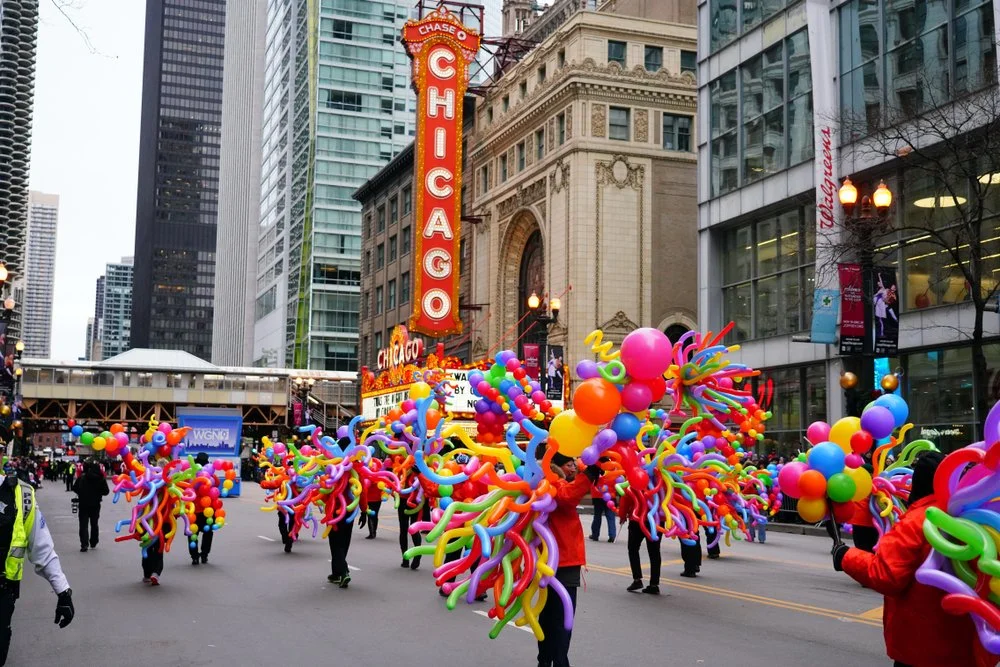
Chicago has a big one that originated as a Christmas parade.
In 1934, the United States had been in the Great Depression for six years. Many leaders in Chicago searched for ways to boost the economy as well as public spirit. Walter Gregory, President of Chicago’s State Street Council, proposed a Christmas parade to Chicago Mayor Edward Kelly in the hopes that it would improve the moods of Chicago residents. The Mayor agreed to the parade, being primarily interested in its potential to improve Chicago’s economy.
Chicago’s first Christmas Parade was on State Street on December 7, 1934. Gregory and a costumed Santa Claus led the caravan, which was filled with toys and various merchandise from State Street businesses. As the city’s government officials had hoped, the parade contributed to desirable growth in the local economy and 1934 held the city’s largest holiday buying period since 1927. This was both exciting and surprising for the entire city. Not only was it the Depression, but that day held dangerously low temperatures throughout the entire state. Some areas of Illinois were as low as fourteen degrees below zero (Fahrenheit).
As you go further west, there are fewer Thanksgiving Day Parades. Houston appears to have the most westerly big parade.
Houston first held a Thanksgiving Day parade in 1949, when Santa arrived at Union Station and rode his sleigh to the Foley’s department store. The Foley’s Thanksgiving Day Parade began two years later, with the retailer remaining its primary sponsor through 1994.
Of course everyone loves a parade, so some places out west have a functional equivalent. In Los Angeles, for example, we find a Hollywood Christmas Parade, on the Sunday of Thanksgiving weekend.
Welcome to 92nd Hollywood Christmas Parade, a cherished tradition that kicks off the holiday season with spectacular fanfare. Since its inception in 1928, the parade has been a cornerstone of the entertainment industry, drawing participation from legendary celebrities such as Gene Autry, Jimmy Stewart, and Mary Pickford. The inaugural event captured the hearts of the Hollywood community and set the stage for a beloved annual tradition. Over the years, this iconic event has continued to feature today’s biggest stars, but is not just a parade; it’s a vibrant celebration that brings the Hollywood community together, enchanting audiences with dazzling floats, marching bands, and performances that create unforgettable memories.
Happy Thanksgiving, everyone, whether you are a parade afficionado or not.

Wow, crazy!