
Election Day, Citizenship and Voting.


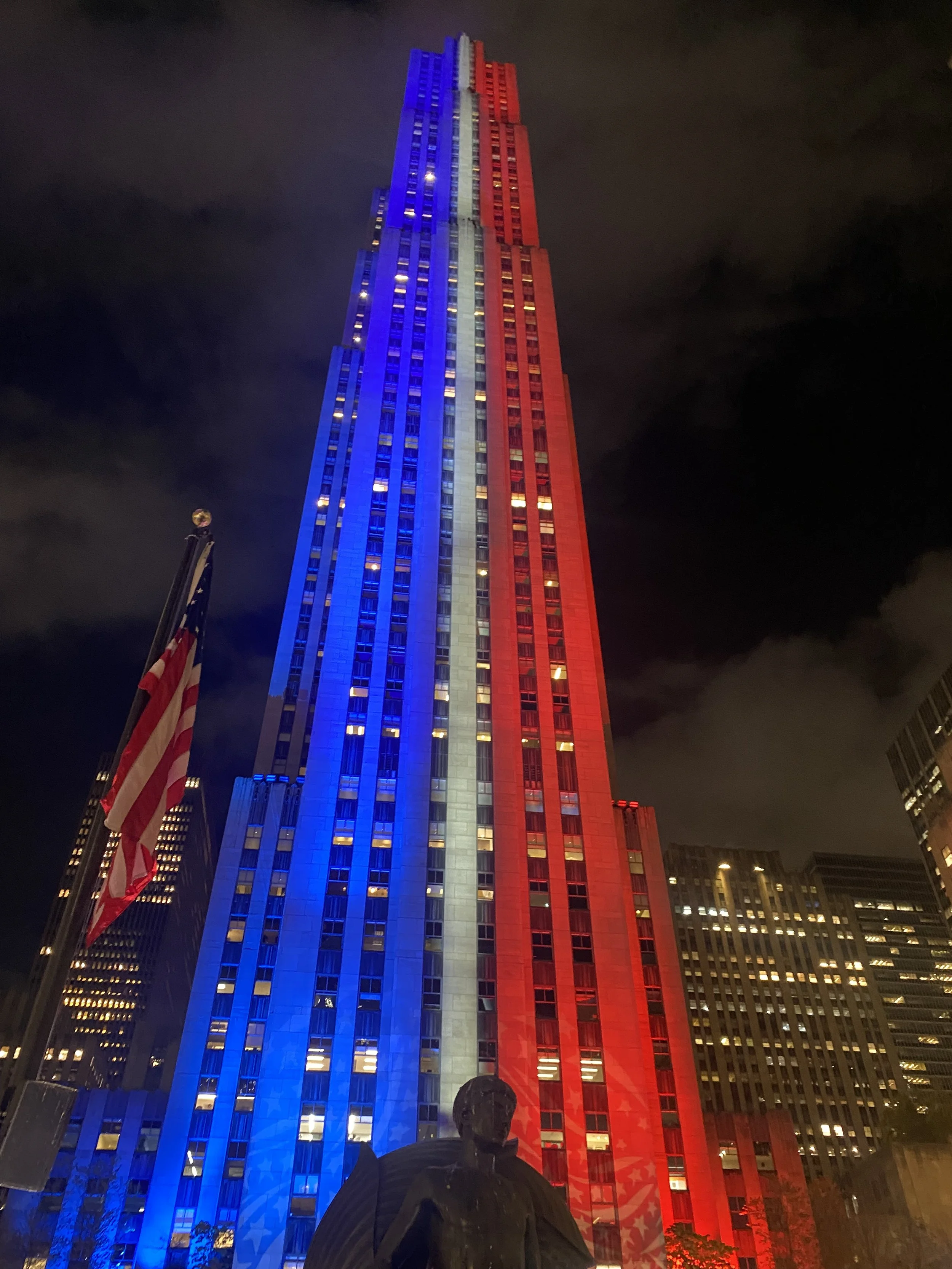
By Karen and Erica
Election Day has finally come and gone. We have chosen our next president, and those to whom we have given control of Congress and the Supreme Court and all fifty state and local governments across the country.
Election Day always reminds us how amazingly lucky we are to be citizens of the United States. We grew up very patriotic at a time when the United States was ascendant. We remain very patriotic. The United States is ascendant again, economically, after the dislocation of Covid. But every day presents new challenges, both external and internal, to our status in the world. Who we elect is critical. We will get the government we vote for.
The most basic obligation of every citizen of this great nation is to vote. Voting is also the most basic exercise of power. When someone offers us power, we take it. We are baffled by the fact that that many do not—though this year was likely different.
Overall, 70% of U.S. adult citizens who were eligible to participate in all three elections between 2018 and 2022 voted in at least one of them, with about half that share (37%) voting in all three.
Perhaps some are of the view that no individual, and no individual vote, matters. We disagree, and so did Sandra Day O’Connor:
My experience in the executive, legislative, and judicial branches of government and my position on the Supreme Court all point to this conclusion: an informed, reasoned effort by one citizen can have dramatic impact on how someone, like a legislator, will vote and act. When I was in the legislature, one person, sometimes with a direct interest in the matter, sometimes without one, would on occasion persuade me by the facts, by the clarity of the explanation and by the reasoning, to do something which I never would otherwise have done. I have been at caucuses when a group of legislators was trying to decide what to do, and, time and time again, my fellow legislators would refer to the logic or fairness of what some plain, unknown citizen has said.
******
The individual can make things happen. It is the individual who can bring a tear to my eye and then cause me to take pen in hand. It is the individual who has acted or tried to act who will not only force a decision but be able to impact it.
One way to ensure greater turnout is civics education. People are not born with an innate understanding of what the government does and what citizenship means. Civics used to be a critical part of pre-college curriculum. No longer. Choosing not to teach civics creates predictable results.
Following the passage of the No Child Left Behind Act in 2001, a heightened emphasis on basic reading and math skills and an increase in the amount of instruction time devoted to such subjects and to preparing for standardized testing resulted in a corresponding decrease in time allocated to civics and history learning. This reallocation continued in subsequent years as schools placed greater emphasis on teaching STEM (Science, Technology, Engineering, and Math) subjects, again often at the expense of civics and history. This decreased focus on civics education has unsurprisingly resulted in reduced civics knowledge amongst young people. As described by Shawn Healy, Senior Director, Policy and Advocacy of iCivics (a nonprofit organization dedicated to promoting civics education that was originally founded by former Supreme Court Justice Sandra Day O’Connor), the decline in civics education “coincides with stagnant student proficiency (a stunningly low range of 20-25 percent) across multiple iterations of the National Assessment of Educational Progress (NAEP) in civics.” Emphasis added.
We value our citizenship. Civics education, and voting, are surely a small price to pay for being a citizen of this great country.
Let’s vote for that.



We want to hear what you have to say.