
London and Munich. A Pleasant Duo.

By Karen
Recently, I was lucky enough to return to London–to accompany my husband on one of his frequent business trips to that city—and then to travel to Munich.
London was its excellent self. Happily, a tube strike ended the day before we arrived. Sadly, we did not miss a huge anti-immigrant march that took over part of the city. Nor did we miss the shenanigans at Windsor Castle resulting from a planned visit by the President while Buckingham Palace is under renovation. London is never boring.
As always, we ate well. Among our new finds:
- Hauser & Wirth’s Mount St. In Mayfair. Interesting art, excellent food, convivial atmosphere.
- In Belgravia, La Poule au Pot. Classic French food in a very low key atmosphere. A fine place to dine with old friends.
- Akub. A lovely, innovative Palestinian restaurant in Notting Hill. Friendly, knowledgeable staff, and absolutely delicious food.
- Benares. In Mayfair. Elegant, with food that is an innovative take on traditional Indian favorites.
Notting Hill was new to me. A real pleasure for an afternoon stroll. Small, pastel-colored homes, lively sidewalk cafes, interesting stores, including:
- The Spice Shop, Go for the smell.
- Couverture and the Garb, Casual clothing for men and women.
- Daunt Books, an excellent selection and cosy surroundings.
I also spent some time exploring Southbank, on the other side of the Thames, home to the London Eye. In a few years this neighborhood has gone from slightly grungy to incredibly cool. It is the one place in London offering an expansive view of the city, and a few attractive new residential buildings have taken advantage of that opportunity. Near them, I picked up tasty, seedy crackers at Gail’s Bakery for a mobile lunch, and looked longingly at many other fabulous baked goods. I wandered around Borough Market, which has expanded from its original building to take over the neighborhood. Wonderful food, to eat there or take home. Always bustling.
We saw only one play, Inter Alia, at the National Theatre. It was brilliant. Now closed, but sure to reappear somewhere. The play feels a little slow at the start, but imperceptibly it ties you in knots from which there is no escape.
Munich
On to Munich, to see friends. We stayed at the Rosewood Munich, a beautiful hotel that well represents the refined spirit of Munich. Chief concierge Victoria Asbach, and Director Claus Banczyk, made us feel so at home.
We quite fell for the city. Unlike our home town, Munich is quiet, yet many streets and courtyards and parks host large sidewalk cafes where half the population of Munich seems to spend time–when not in beer gardens. A wide pedestrian avenue is lined with international shops, and local stores can be found in lovely narrow side streets. Munich residents seem happy with their lives—perhaps because Munich has overcome a dark history.
Oktoberfest was coming. Dirndls and lederhosen were for sale everywhere, as were gingerbread hearts with messages of love. Horse-drawn, decorated wagons loaded with barrels of special Oktoberfest beer, made by every local brewery, rolled through the streets. (Be warned—Oktoberfest beer is much more alcoholic than everyday beer.) Everyone seemed very excited, even though the city’s approximately 1.6 million must be overwhelmed by the 6 million annual visitors.
We started our exploration of the city with a walking tour conducted by an American who fell in love with Munich while in school, and never left. He opened our eyes to all kinds of sights we would have missed, like a centuries-old cannon ball embedded in a church window frame. He told us all about the many buildings that look old, but are actually copies of those felled during the Second World War. And he took us to Hofbrauhaus, where he explained beer options, of which there are many, and the way beer gardens and halls operate. Important information.
After that, a friend arranged for us to see the workshop of Hemmerle, a virtuoso family-owned jeweler founded in 1893. The remarkable and articulate artists that create its one-of-a-kind jewelry explained how they combine ancient techniques and modern vision. Just fascinating.
We dined very well in Munich too!
- Dinner one night was at a revered older restaurant, Restaurant Kafer-Schanke. We loved the beautiful Bogenhausen neighborhood in which it resides, as well as its excellent food and wine, and impeccable service. A Michelin star was well earned!
- Our friend took us to an equally revered Italian restaurant, Osteria Italiana, where we ate far too much pasta with white truffles, and drank far too much Italian wine. We regretted nothing.
- For something very different, we dined on sushi at Azuki, a mostly Japanese restaurant. Excellent.
- We were excited to stumble upon the Dallmyer Delicatessen, an elegant food store with all kinds of wonderful breads and cheeses and chocolates and wine. Perfect for picnics in the English Garden.
- Munich’s open air food market, Viktualienmarkt, cannot be missed. It is a great place to sit outside for big, soft brezels with obazda—a mandatory accompaniment to a stein of beer. As is another outdoor beer garden, Chinesischer Turm, in the English Garden—overseen by a Chinese temple, of all things.
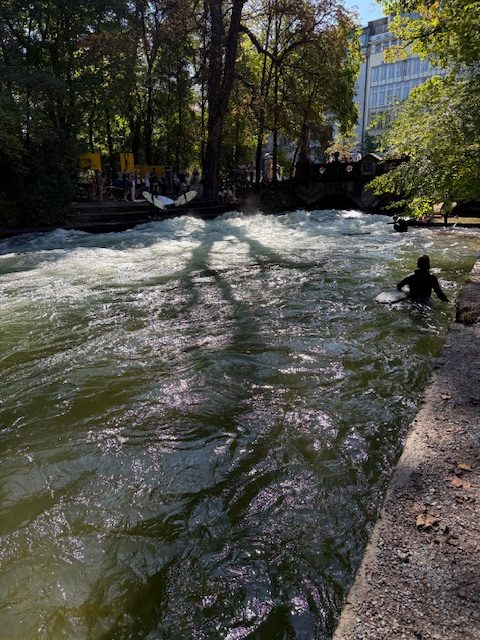
The very aptly named English Garden was gorgeous on an unexpectedly summery day, full of sunbathers and picnics and dogs. We were especially enchanted by a rushing, yet lyrical, humanmade stream that is home to Munich’s surfers. And swimmers. Completely unexpected and totally entertaining. (It appears to be very difficult to stay on your surfboard for too long.)
Also a treat, in different ways, were a couple of museums.
- Lenbachhaus is home to works of the Blue Rider Group, avant garde artists of the early part of the 20th century. We love this period, and the museum is exquisite.
- The enormous Munich Residenz, a palace that was extensively renovated after the war, is full of glorious courtyards and ornate rooms, one of which features sculptures covered in shells and stalactites. Very compelling. Indeed, we ended our stay with a delightful harp and flute recital in one of its chapels.
- We were impressed and unnerved by the Munich Documentation Center for The History of National Socialism. Housed in an elegant building, and well laid out, the rise of Naziism is explained, in pictures and videos. Chilling. Hopefully not foretelling Afterwards we came upon Viscardigasse—a small cobblestone alley where a curved path of bronzed stones can be seen, signifying that the alley was used by those who did not want to walk where they would be required to make the Nazi salute.
I learned all kinds of tunexpected hings–especially about beer and urban surfing–during this short, but packed, trip. Travel at its best.



We want to hear what you have to say.