
WHAM! BAM! I’m Not A (Little) Man!


By Karen
Did you know that much of the research performed on drugs, even now, is done on males only? First, male rats, then male humans. Why? Because females have hormones so obviously it is too troublesome to study their reaction to drugs. Even though women are 52% of the U.S population. Arguably, a majority.
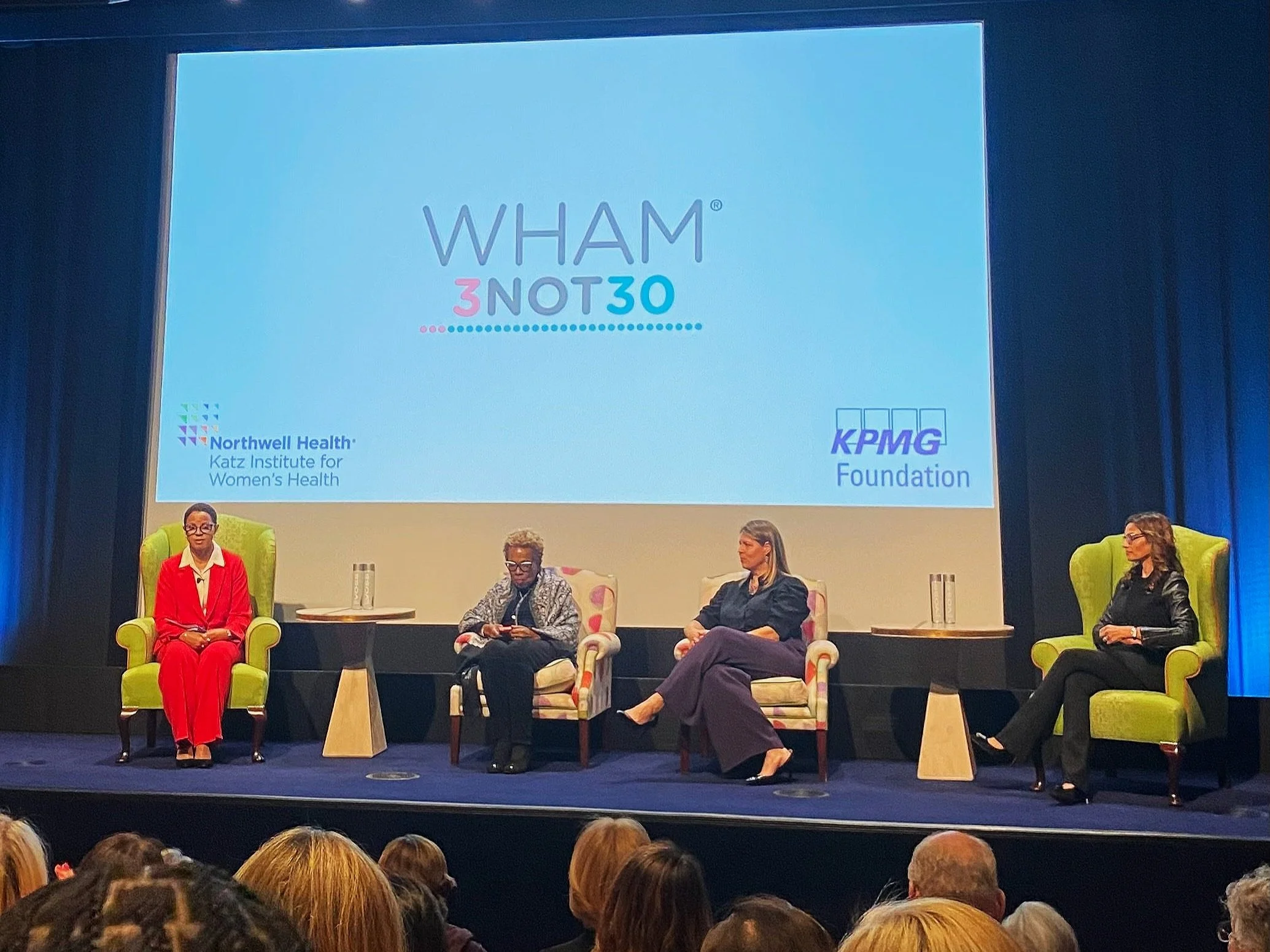
About six years ago, Stacey Rosen, Senior Vice President for the Katz Institute for Women’s Health, first told me this startling bit of information. I remain startled. And I did not get less startled when I attended a fascinating presentation, co-sponsored by The Katz Institute for Women’s Health, and WHAM, about the state of women’s health.
First, what are the Katz Institute and WHAM?
The Katz Institute is a part of Northwell Health focused on educating the medical profession to the fact that women are not little men.
When it comes to health and medicine, women have long been understudied, undertreated and misdiagnosed. In fact, most research and clinical trials in our country only included men up until the early ’90s. That’s why we’re putting women first.
WHAM is an acronym for Women’s Health Access Matters. It was started by Carolee Lee, whose jewelry you probably wear. She sold her company and became a powerful and tireless advocate for women’s health. Perhaps because Ms.Lee is a successful businesswoman, WHAM has a positive focus on money.
Doing research that includes women (and other people who have historically not been part of clinical trials, like rural residents and black people) will provide huge economic benefits as the research translates into health benefits. Indeed, WHAM issued a report which found:
If we invest $300 million in women’s health research across just three diseases, we get $13 billion in returns to our economy.
Think about these facts:
-
The genes in every cell of every human body are either XX or XY. Every cell!
-
Plainly, sex differences are not limited to reproductive organs—what Dr. Rosen refers to as the bikini area. Sex differences are pervasive.
-
These sex differences affect the functioning of every bodily organ and tissue. Even blood.
-
Once at least some research into sex differences started, the discoveries were profound. For example, it was learned that when men’s immune systems are activated, men’s bodies summon the army to fight an invader. When women’s immune systems are activated, their bodies summon the army and the navy and the airforce and the space force. Sometimes that’s a good thing. Sometimes it is overkill and leads to different problems. The point is—studying men’s bodies will tell you little about women’s bodies.
-
In 1977, women of childbearing age (defined as 9 to 50) were first excluded from clinical trials by the FDA after thalidomide and other drugs caused serious birth defects. Not a crazy policy but perhaps the consequences of not studying women should have been further considered.
-
Thankfully, those consequences were further considered. In 1993, the FDA rescinded that 1977 policy, and Congress passed the NIH Revitalization Act of 1993, which mandates participation of women in clinical trials.
-
But as the WHAM report shows, only a small fraction of NIH funds are spent on women—even with regard to diseases that have the greatest effect on women, like heart disease and Alzheimers. Research on these and other diseases is chronically underfunded.
-
And even where women may not be at the most risk, sex-differentiated research could help everyone. In a recent study, where data were separated into four groups—women with and without the disease, and men with and without the disease, a new chromosome was discovered in the data of women without the disease. That information, which would not have been found had the data not been separated by sex, will help in development of a drug to alleviate the disease in both sexes.
-
One reason women’s research lags may be that the whole health ecosystem lacks a sufficient number of women in many critical professional categories—not just among doctors and nurses. The ecosystem therefore has no innate instinct to include women.
-
Another reason may be that most funding focused on women is directed to reproductive health. Reproductive health is critical, but only a part of the picture.
-
For example, in 1985 mortality rates for women and men with heart disease crossed, and women’s rates have continued to rise while men’s have fallen. While it was long thought only men suffered from heart disease, we now know it is the number one killer of women in the U.S. Obviously, research into women’s heart disease is as important as research into women’s reproductive systems.
-
A future negative effect of neglecting women’s health research is artificial intelligence. Big databases that will inform generative AI health initiatives are scraping existing data, which lack sufficient diversity. Outcomes can be expected to be biased.
-
Older women are especially invisible in the health ecosystem. Have you ever been told by a doctor that you have an identified illness but there is no data on how to treat the condition a woman of your age? That’s because there is very little research.
-
Keeping women healthy is critical for many reasons, one of them because it has a multiplier effect. When women get sick, not only do they become less productive, but, since they are also principal caregivers for a range of other people, those people too become less productive.
-
As we learned during the pandemic, drugstores are a major, and trusted, part of the health ecosystem. They should be a continuing source not only for treatment—like vaccinations—but also for data. About everyone.
So where are we? Seems we are moving along, but it would benefit everyone, and the economy, if we moved faster. So let’s do exactly that. Support WHAM’s 3 Not 30 campaign. Join clinical trials. Sign up for the Katz Institute’s newsletter. And make sure your doctor knows you are not a little man.
PS: Hot off the press: Yesterday the White House announced the establishment of the first White House initiative on Women’s Health Research, to be led by Jill Biden. Onward!!



We want to hear what you have to say.