
Did Recent Political Commentary Make You Fear Age?


By Erica and Karen
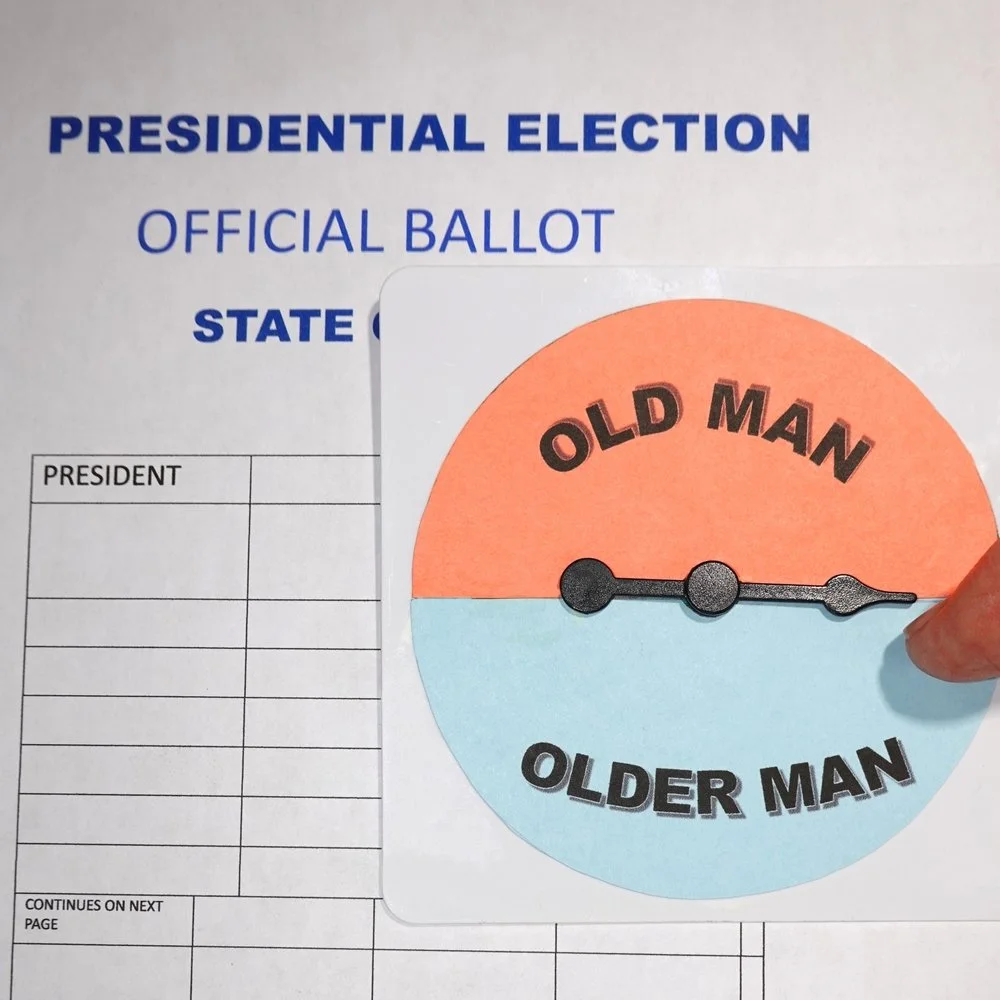
The ages of the two men who were the leading presidential candidates this year became a constant media focus. Some of their performances did too—for one, a really bad debate, for the other, sleeping during his criminal trial and an odd focus on Hannibal Lecter. (We are not qualified to opine on which issues are connected solely to age.) The media would have you think that everyone even close to 80 was losing their ability to function in the real world—and would only get worse. So who would want to grow older?
Lustre’s view is that it is nutty to fear getting older.
First—there’s the alternative. It’s not pretty.
Second, with every passing hour you get better. Maybe some of your body parts get a little dodgy—biology has not evolved with advanced life expectancy. But there is no other way to gain the experience that comes with years of living, and experience gives life an invaluable perspective—as well as abilities not available to younger people. A phrase we love—the younger run faster but the older know the short cuts.
Third, trying to make it in the world is no longer your sole focus—which is liberating. You have already made it, at work and in your life. You may be trying to make it again—like we at Lustre are doing—but making it is now on our terms—at least to some extent. And it is a little less dramatic. We know that there will be ups and downs, even failures, and we can keep enjoying the journey no matter what—at least to some extent. While we are not among those that think we should do nothing other than smell the roses as we rock out on the back porch—we do like to smell roses, and to play, and to have time to ourselves. But we are among those not ready to stop completely.
We agree, of course, that age is unidirectional. (There are those in Silicon Valley who think they can flatline the progression of age. The idea of spending untold resources on that fantasy does not appeal to us.) But age is not what it used to be, thanks to a focus on public health in the middle of the last century (that we might consider reviving today).
Today, our perception of age is changing more than ever. Thanks to advancements in science, medicine and technology, we may be living longer – well into our 70s, 80s and even 90s – and accordingly we will need to continue to redefine what it means to be “old.” These advances also present an opportunity to start thinking about a not-too-distant future where aging may not mean losing vitality and functionality physically, mentally and emotionally but maintaining or even gaining it as members of a new generation making meaningful contributions to society.
Age is not just a number, in our view, but age is one of many factors to consider when evaluating a person’s ability to perform.
“One troubling aspect of the recent discussion about age and Biden’s decision is that people are linking shortcomings of older people to their age alone, rather than any underlying disease or condition, says Laura Carstensen, director of the Stanford Center on Longevity.
“Younger people make mistakes all the time and we don’t say it’s because they’re 50,” she says.
Based on what we understand, it is not rational to assume everyone over 80 is non-functional. Or that anyone under 80 is functional. Some, indeed, seem rather wifty long before 80. And it is not irrational to accept that some people do succumb to diseases, like dementia, that affect the ability to think. But to presume that all people over 80 are mentally infirm is counterfactual and agist.
To assume everyone over 80 is infirm is also counterproductive, first because a particular person might not have any infirmity, and second because if everyone assumes that all older people are losing cognitive function, older people will be treated as lesser human beings, and will be ostracized, and that will lead directly to the catastrophe people worry about. We like what this doctor has to say:
Our desire to live longer is difficult to reconcile with society’s treatment of people who manage to do it.
The solution? The same as it has always been. Evaluate each person you meet, whatever their age, on her or his own merits. Even if they are politicians. And disclaim the false narrative that everyone over 80 is cognitively impaired. That misleading assumption only limits opportunities for our future selves, should we actually be lucky enough to grow into them.
And one bright note: One of the candidates has now passed the baton to a woman who is nearly 60. The age-focussed media calls her young. Progress, maybe?




We want to hear what you have to say.