
Are Our Feelings And Our Faces Mismatched?

By Karen and Erica
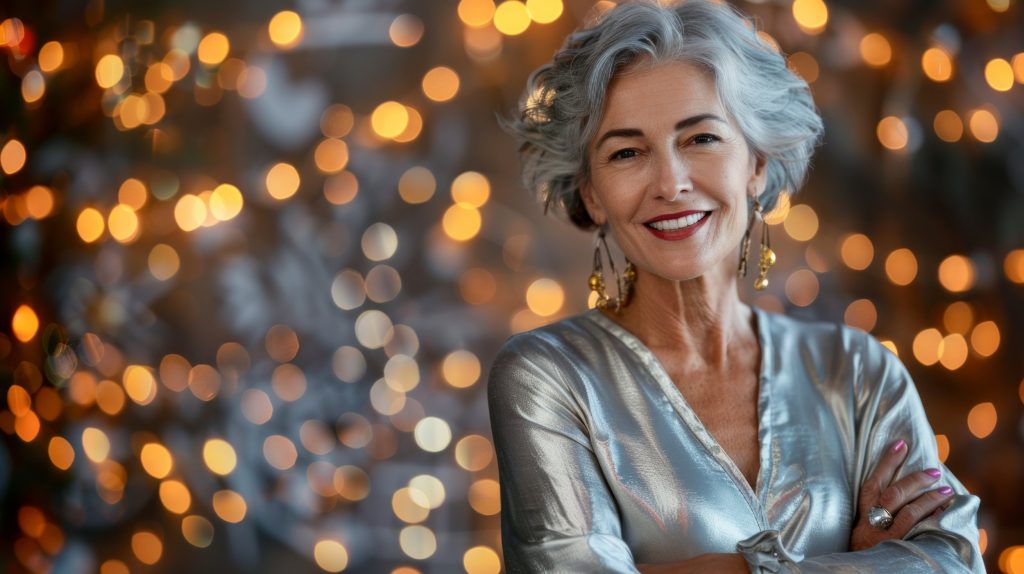
You likely have been told: You look great for your age. We’re sure you do look great. But you look your age. How else could you look?
The idea behind this saying is, of course, that a woman over a certain age (forty? fifty?) is not going to look too good, so if you have held it together at all, you should be praised. And proud. And because that idea is something we have all grown up with, even though it is profoundly agist, it affects how we feel about ourselves.
What does this nefarious saying do to us? It makes us see a difference between how we feel—vibrant and vigorous—and how we think we look in the mirror—some age that is not vibrant or vigorous. It turns out this is because we are programmed to think vibrant vigor belongs only to younger faces than the ones we achieve when we achieve age.
The apparent mismatch between how we feel and what we see causes mental dislocation. This dislocation even has a name: the mask of aging.
There is a decades-old term I only recently learned of that helps explain this strange paradox. It’s called the mask of aging).
The mask of aging represents the phenomenological experience of some women as they age, in which they cannot reconcile their inner youthful selves with their aging external bodies. This contrast between how they feel and how they look can be disorienting and upsetting.
On the inside, they feel young and vibrant. Having also gained the benefit of wisdom that life experience brings, they now feel both young and wise—a winning combination that is sure to raise self-esteem and self-image.
But when they gaze in the mirror and see a woman who looks quite wise but not very young, the mismatch is difficult to accept. Their reflection of this aging woman is experienced as a betrayal of the young woman to whom their inner identity is bound. This incongruence becomes a threat to their self-worth.
Luckily, perceptions are slowly changing.
It Is difficult, both globally and locally, not to be aware that the identities offered to older adults are becoming more diverse. A tendency to redescribe aging as a time of activity, social engagement, and productivity rather than of decline and dependency has influenced thinking, nationally, regionally, and globally, and is reflected in the United Nations declaration of the Second World Assembly on Ageing (2002). Stereotypes that may have held 20 years ago are becoming increasingly unstable and, like the statues of so many 20th-century dictators, are liable to imminent collapse.
We look forward to the imminent collapse of this antiquated presumption, so everyone can see the truth—those of us over 30, as well as those of us well beyond 65, look just grand. Elegant, aware, wise, happy. We don’t look all wide-eyed and dewy. But why would we want to? Well, maybe because we have been hearing all of our lives that younger women are more desirable than older ones. But that is a myth to which only those with a narrow view of women’s value subscribe.
Youth is wonderful. But as women get older, we get better. For one thing, we become excellent leaders.
Indeed, the image of the lonely, cranky senior simply doesn’t match reality. Instead, we tend to be happier as we age. The older adults we surveyed (in their 60s, 70s and 80s) were more likely to report feeling calm, optimistic, cheerful and full of life, and less likely to report hopelessness, restlessness, nervousness or sadness, than those in their 20s, 30s and 40s. The results are supported by a body of scientific literature showing that happiness is roughly U-shaped, dipping at mid-life and increasing as we age.
This is good news for leadership, because who wouldn’t want a calm, optimistic boss? These traits aren’t simply plusses, but actually provide the bedrock for solid leadership. By being the center of calm, leaders inspire those around them to do their best work because everyone is operating from a place of trust.
As many of us have experienced, emotions are contagious, as are mental states, whether positive or negative. When leaders operate from a place of confidence versus insecurity, the ripple effect brings teams together rather than pushing them apart. Less stress and doubt at the top is good for the entire food chain.
For another, older women (and older men) benefit hugely from healthy longevity, and from all the wonderful new options for keeping disease at bay. As a result, for the first time in history we can be both experienced and full of life at the same time. That’s why we feel so vibrant. And that’s why our faces, reflecting our years of life, are a perfect match.
Indeed, this congruence between experience and health is truly historic. The world needs to take advantage of the amazing new possibilities it offers—especially for older women. But, for older women to achieve full social recognition, we need to advocate for women at all ages so that we all learn together the value at each age.
The hard truth is that older women are perpetually excluded from global policy and advocacy discussions because of the insidious nature of ageism and sexism. We need to push for the inclusion of women in all advocacy talks, at all ages and life stages. This doesn’t just mean discussions about women’s rights, but also human rights in general.
There’s no reason to separate the conversation by age group; we’re all family, friends, and community members. We have interconnected relationships that are not arbitrarily compartmentalized by generation or biological age. Issues pertaining to one generation affect the others (and our future selves), so it makes sense to work together and shore each other up. Applying a life course perspective to social policy development can help protect the rights of women from youth through older age.
If women at every age are valued for what they have to offer at any age, when we look in the mirror we will see ourselves exactly as we are—women who look the age we have achieved, beautiful and vigorous. Women who are ready to lead.

We want to hear what you have to say.