
In Japan, Twelve Quirky, Unexpected and Amazing Experiences.

By Karen
My family and I just returned from a two week trip to Japan. We had never been there before. I prepared carefully by rereading Shogun, and watching the show. Actually, not a bad introduction! (Yes, I did read a few other things!)
Here are ten observations about the trip to Tokyo, Naoshima and Teshima, Kyoto, and Hakone:
-
Tokyo is massive. Of course you know that, but seen from the vantage point of the Tokyo Skytree, a high viewing platform, its reach is startling. Visually, it is different from some large cities in that many buildings appear to have been placed wherever, leading to a slightly higgledy piggledy look from on high. Earthquake risk?
-
No-one jaywalks. Even in the gigantic Shibuya Crossing, where close to three thousand people cross every time the light changes, no-one even steps into the intersection until the lights turn green. For a New Yorker, this is incomprehensible behavior. I can’t imagine my home town without jaywalkers. (Btw, back in the early part of the 20th century a jay was a rube who did not know the rules of the road, and got in the way of the newly ubiquitous cars. Hence jaywalker.) But this social attitude seems emblematic.
-
The carp are gorgeous! The ponds in many glorious gardens are full of the fattest, shiniest, most gleeful carp ever. We saw our first school in the magnificent Ninomaru Garden at the Imperial Palace, and many more after that. Apparently only black carp get eaten, so these gold and silver and orange fish are confident as they dance around each other, swishing their elegant tails
-
Some of Tokyo’s modern architecture is brilliant—inventive and playful, especially in one neighborhood where, I learned from our excellent guide, three of my favorite designers—Issey Miyake (clothing), Yohji Yamamoto (clothing), and Tadao Ando (buildings) apparently knew each other as young men and began then to collaborate on projects. They still do. I also loved Tokyo Tower, which looks a bit like the Eiffel Tower except it is a racy red. Its construction was apparently an effort to one-up Eiffel and raise Tokyo’s global profile.
-
Kitchen Street is heaven for cooks. All kinds of marvelous pots and pans, devices you need but have never heard of, and especially beautiful knives, of all shapes and sizes. One of our group was exceptionally knowledgeable about how knives are made, and the purpose of each shape. Fascinating. I need to up my knife game.
-
Japanese dining includes salad only at breakfast. All is delicious, as are the many places in which to buy food. I was entranced by the various open air markets—Tsukisi Fish Market in Tokyo, Nishiki Market in Kyoto were two—and by the food halls—depachika—in the basements of department stores. I have never seen larger, more beautifully wrapped, fruits in my entire life.
-
There are many kinds of ramen. And thousands of ramen shops. A ramen row can be found in the basement of the Tokyo train station, but there are so many others. In some places, you can specify how many grams you want when you order at a machine on the way in. Do a taste comparison—but do not eat anything else all day. And there are rules. Do not stick your chopsticks upright in the ramen! Our very amusing and extremely tall guide was appalled! And do not socialize while eating. Get in and get out!
-
The Shinkansen are sleek and fast and fabulous. And they just turned 60. Why can’t we have bullet trains? Why haven’t we had them for sixty years, for that matter?
-
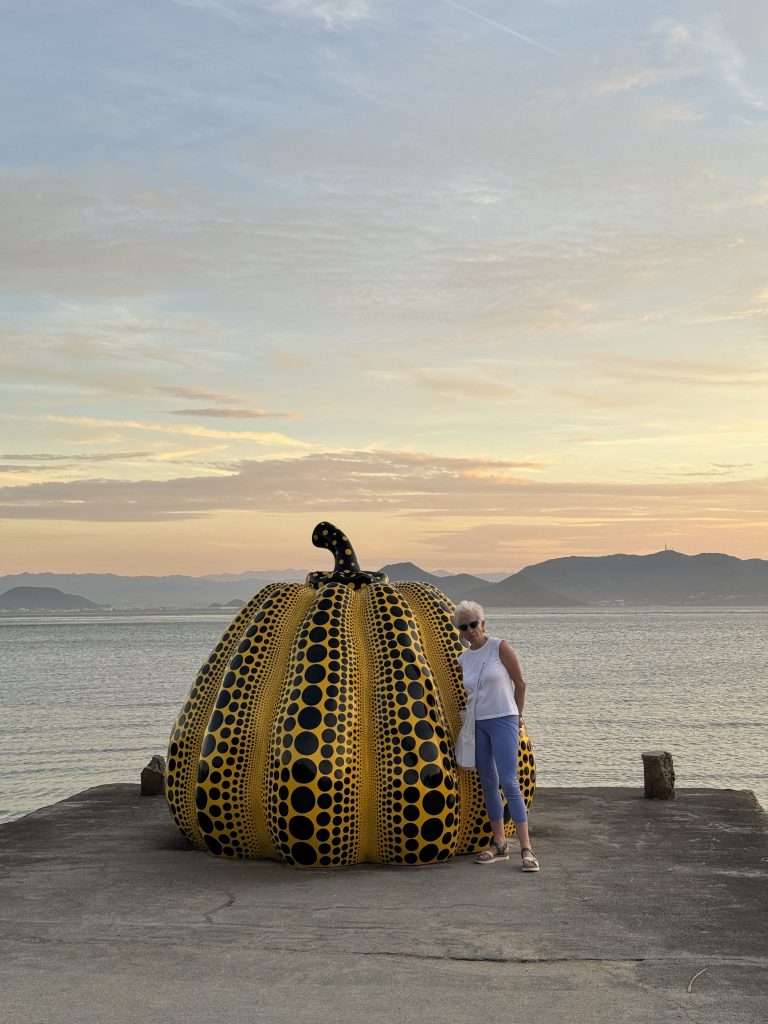
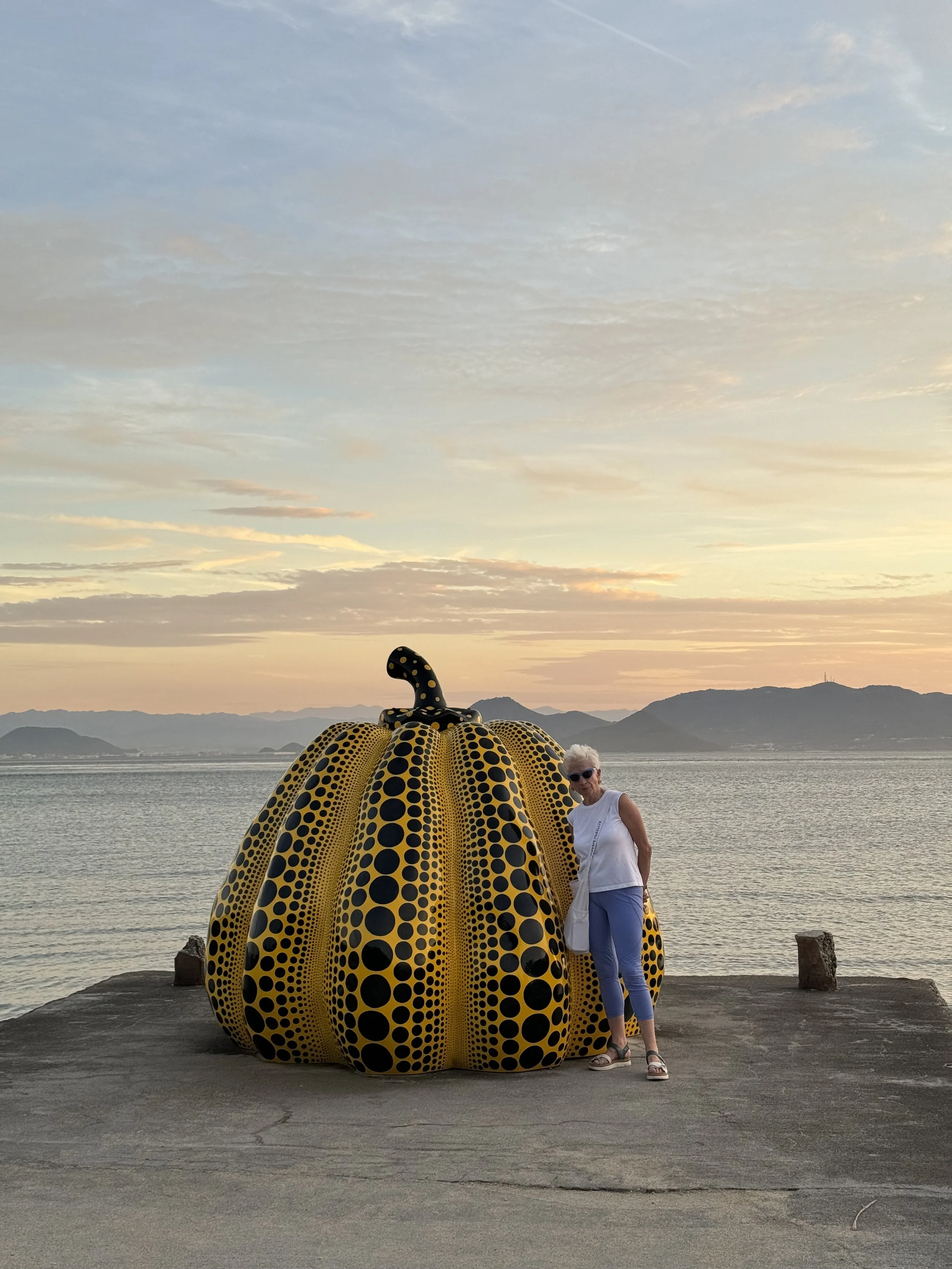
The art islands are sensational. Benesse House, the hotel on Naoshima, part of the Benesse Art Site, is a gorgeous Brutalist museum that houses fantastic works of art, many by Hiroshi Sugimoto, an artist whose work I love. The rest of the island is populated with indoor museums and outdoor sculptures, all brilliantly placed. The Teshima Art Museum is a water droplet that has fallen into a brilliant green rice terrace. I could have stayed all day, watching the light change and the drops of water that constantly arise from the floor and flow into different patterns.
-
Kyoto is nothing like Tokyo. I loved walking around Gion. All kinds of fun shops and the home of the famed Geiko, performers whose study begins very young. Kyoto is also the site of many many temples, which is perhaps why it was not bombed during WWII. Everything is steeped in centuries of history, the like of which is simply not part of my usual daily experience. Many of Kyoto’s temples have bright orange gates. One of the most stunning has a thousand such gates. You have to respect any culture that embraces such a vibrant color. And for a different immersive color adventure, i walked through Kyoto’s bamboo forest. I felt as if I was under water. Sublime. Finally, I attended a tea ceremony. These ceremonies were created by samurai to induce calm before conflict, and are also steeped in centuries of history. I am impressed that the samurai could feel calm while in the seiza—sitting with one’s legs folded under you. I failed to do it at all.
-
Traditional ryokan life is an acquired taste. We all loved Hakone, a gorgeous town set in beautiful mountain scenery, with a incredible Open-Air Museum and many hot springs. We stayed Gora Kadan, a (fancy) ryokan, where we all wore yukatas, light cotton kimonos, and sandals everywhere, including to dinner, and especially to the community hot bath, or onsen. Once in the hot bath, no clothing at all is permitted. No tattoos, either. Not all of us were sold on this particular venture, and not all of us were bold enough to try an onsen, but one of us jumped in with both feet! (Actually, no jumping in the onsen either.)
-
We knew Japan liked robots and now we know why. When we were back in Tokyo before the long trip home, a bright green Uber Eats robot came scampering up the sidewalk towards us. Cute as a button! Some people looked at it and smiled. Many treated it as any other being on the sidewalk and simply got out of its way. Wonder how it would fare in the US???
The trip, arranged by Essentialist, was great—a splendid family adventure. There is, of course, much more to see. Another visit is surely mandated.
PS: I now have it on good authority that there are jaywalkers in Osaka. What does that mean, culturally speaking?
Have you been to Japan? What would you highlight?


Karen is 100% right on everything! Especially that Japan is worth visiting…even if you don’t have two full weeks…even if you have been elsewhere in Asia. I returned from a first trip there a few days ago and found her observations on point…and useful.